
Transforming Genetic Imagination with Technology First Thinking
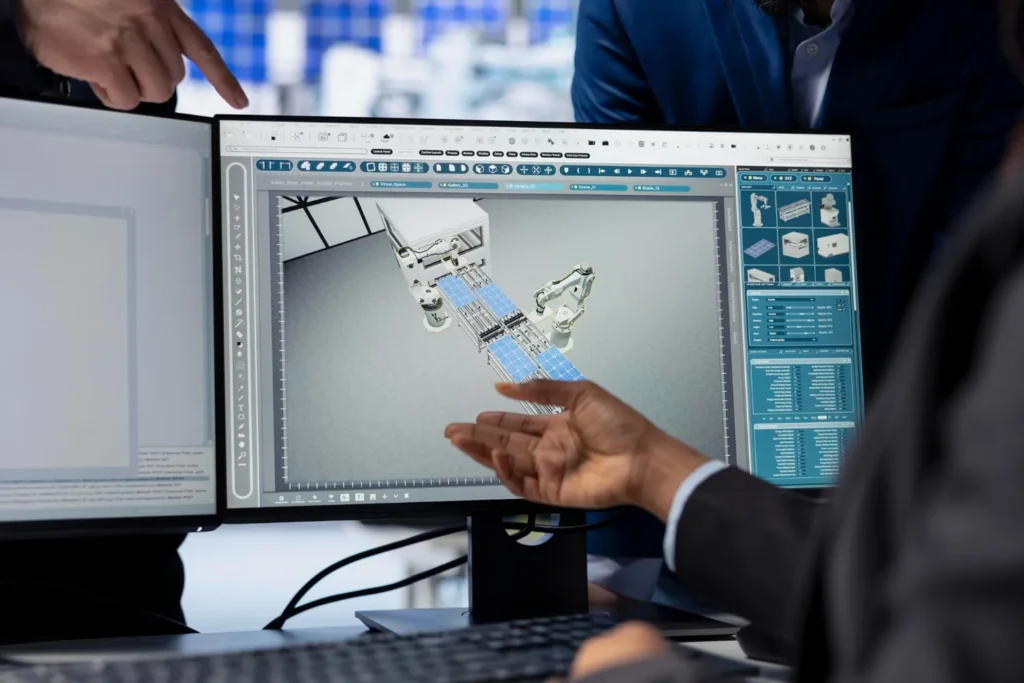
Synthetic Biology in life sciences involves the design and construction of new biological parts, devices, and systems, as well as the re-design of existing natural biological systems for useful purposes. This interdisciplinary field combines biology, engineering, genetics, and computer science to create synthetic life forms or modify existing organisms to perform novel functions. Software Solutions plays a critical role here by automating laboratory equipment, facilitating collaboration among researchers, and analysing complex datasets.
Lab Automation
Behind the Scenes of a Smart Lab: The Role of Firmware in Modern Laboratory Automation
Biological System Modelling
Biological system modeling in synthetic biology refers to the use of computational and mathematical approaches to represent, simulate, and predict the behavior of biological systems that perform specific functions, such as producing biofuels, pharmaceuticals, or detecting environmental pollutants. Synthetic biology involves creating complex genetic circuits, pathways, and organisms using various modelling approaches which help in understanding how these engineered systems will behave before they are experimentally implemented while reducing the need for costly and time to be spent on.
Genetic Engineering
Genetic Engineering in Synthetic Biology involves the deliberate modification of an organism’s genetic material to create new biological systems or improve existing ones for specific purposes that can perform a wide variety of functions across different fields, such as medicine, biotechnology, agriculture, and environmental science. While genetic engineering focuses on altering specific genes within an organism, scientists can modify and design biological systems by directly manipulating an organism’s genome using advanced techniques and principles of engineering to construct new biological functions and systems or redesign existing ones.
DNA Synthesis & Editing
By integrating both DNA synthesis and editing, synthetic biology enables scientists to create highly customized organisms, opening up new possibilities for bioengineering. Both DNA synthesis and DNA editing are critical in advancing synthetic biology, enabling the creation of novel organisms, treatments, and biotechnological applications that are reshaping the future of science and medicine.
Solutions Expertise Into..
DNA And Gene Synthesis
These services provide access to the tools and expertise necessary for constructing artificial genetic material without the need to extract or clone DNA from living organisms.

DNA sequencing
DNA sequencing services are integral to many applications in synthetic biology, including the design of new genetic systems, validation of engineered organisms, and discovery of novel genetic elements..

BioSensors Integration
It volve the development and deployment of biosensors—devices that use biological molecules to detect and measure specific substances or changes in the environment.

Biological Computing
Software solutions in biological computing services for synthetic biology are designed to enhance the efficiency, accuracy, and scale of synthetic biology research.
BioEngineering
Software solutions play a pivotal role in designing, analyzing, and managing biological systems and processes. These solutions enhance efficiency, accuracy, and scalability..

Artificial Organisms
Artificial Organisms in synthetic biology represent a frontier where scientists design and construct entirely new biological entities or heavily modify existing ones to perform specific tasks.

Drug Therapeutics
Drug Therapeutics Services in synthetic biology involve using engineered biological systems to develop new drugs, optimize existing therapies, and create personalized medicine.

Microbiological Manufacturing
Microbiological manufacturing services involve the use of microorganisms, such as bacteria, yeast, or fungi, engineered to produce a wide range of biological products, including enzymes..

Domains we serve
Lab Automation
Lab Automation refers to the use of technology to perform laboratory tasks and processes with minimal human intervention.
Cheminformatics
We have worked in ChemInformatics niche providing services in data mining and analysis, chemical structure representation..
Synthetic Biology
Synthetic Biology involves the design and construction of new biological parts, devices, and systems, as well as the re-design of existing natural biological systems..
Synthetic Biology
Synthetic Biology involves the design and construction of new biological parts, devices, and systems, as well as the re-design of existing natural biological systems..
Electronic Device Designing
Electronic device designing refers to the process of creating and developing electronic systems or products that serve specific functions..
Health Analytics
Health Analytics in Healthcare involves the use of data analysis tools and techniques to improve patient care, optimize operations..
Synthetic Biology
Synthetic Biology involves the design and construction of new biological parts, devices, and systems, as well as the re-design of existing natural biological systems..
Synthetic Biology
Synthetic Biology involves the design and construction of new biological parts, devices, and systems, as well as the re-design of existing natural biological systems..
FAQ
Frequently Asked Questions
A Cheminformatics software solutions company designs, develops, and deploys custom software applications, platforms, and tools that help chemistry-driven organizations — pharmaceutical companies, biotech firms, agrochemical businesses, and research institutions — manage, analyze, and derive insights from chemical data. UVJ Technologies builds the software infrastructure that powers these workflows: from molecular visualization platforms and chemical database management systems to QSAR modeling tools, virtual screening applications, and automated synthesis planning software — all tailored to the specific research and operational needs of our clients.
UVJ Technologies delivers end-to-end Cheminformatics software solutions across three core disciplines — Data Mining & Analysis, Chemical Structure & Reaction Representation, and Computer-Aided Synthesis Design. Our solution expertise spans Specialized Database Preparation, Data Sharing & Collaboration Platforms, Data Curation/Sorting/Unification, Library Generation, Reaction Rule Scope Evaluation, Reaction Template Mapping, Quality Evaluation of Chemical Features, Chemical Structure Feature Analysis, Firmware Development for analytical instruments, and DevOps Services for Cheminformatics pipelines.
AI and machine learning have fundamentally transformed Cheminformatics. Today, Graph Neural Networks (GNNs) model molecular structures natively — treating atoms as nodes and bonds as edges — to predict biological activity, toxicity, and drug-likeness with unprecedented accuracy. SMILES-based transformer models, deep learning QSAR systems, and generative chemistry platforms are enabling researchers to explore vast chemical spaces computationally before a single experiment is run. UVJ integrates AI and ML into our predictive modeling, reaction prediction, ADMET profiling, and virtual screening services, helping clients compress drug discovery timelines significantly.
Building robust Cheminformatics software in-house requires a rare combination of expertise — chemistry domain knowledge, data engineering, AI/ML development, and regulatory-compliant software architecture — which is expensive and time-consuming to assemble internally. UVJ Technologies brings over 22 years of life science IT experience, a CMMI Level 3 certified development process, and a dedicated team that understands both the scientific requirements of Cheminformatics and the engineering rigor needed to build production-grade software. Our clients get faster time-to-market, lower development risk, and software built to scale.
Regulatory compliance is non-negotiable in life science research. UVJ designs Cheminformatics software solutions with compliance built in from the ground up. Our platforms support FDA 21 CFR Part 11 (electronic records and audit trails), Good Laboratory Practices (GLP), Good Manufacturing Practices (GMP), REACH (Registration, Evaluation, Authorisation and Restriction of Chemicals), and GDPR for data privacy in international collaborative environments. This includes role-based access control, electronic signatures, time-stamped audit logs, data encryption, and version-controlled database architectures — ensuring that all computational research outputs meet the rigorous documentation and integrity standards required for regulatory submissions.
Yes. UVJ has specific expertise in developing software for chemical structure representation, including accurate computational rendering of molecular structures in both 2D and 3D formats — complete with 360-degree rotational visualization. We build applications that generate and manage SMILES strings, InChI identifiers, SDF files, and 3D coordinate sets, with support for substructure search, similarity search, and conformational analysis. These capabilities are built into database platforms, research portals, and standalone molecular viewers, depending on the client's workflow requirements.
Related Blogs